CryptoMox Blog
A Guide to Cryptocurrency Margin Trading
So, you've heard about margin trading in crypto. It’s a powerful tool that lets you trade with more money than you actually have, but it’s a double-edged sword. At its core, crypto margin trading is simply using borrowed funds from an exchange to open a much larger position.
Think of it as putting a down payment on a trade. This magnifies your buying power, turning small market swings into potentially significant profits. Of course, the flip side is that it also amplifies your risk of loss just as quickly.
The Power and Peril of Borrowed Funds
Let's use a real-world analogy. Say you want to buy a house for $500,000 but only have $50,000 to put down. You get a loan for the other $450,000 from a bank, and your initial $50,000 acts as collateral. With just a fraction of the total cost, you now control a half-million-dollar asset.
Margin trading in crypto works almost exactly the same way. The capital you put up is your "down payment," which we call margin. The crypto exchange plays the role of the bank, lending you the rest. This setup lets you command a much larger position, but just like in real estate, if the market turns against you, your initial stake can get wiped out fast.
The Key Players in a Margin Trade
To really get how these trades work, you need to know who's involved. It's pretty straightforward, and every margin trade has these three parts:
- The Trader: That's you. You're the one putting up the initial capital (your collateral), picking the crypto, deciding whether to go long (betting the price goes up) or short (betting it goes down), and choosing how much leverage to apply.
- The Lender: This is the crypto exchange itself, like Binance, Bybit, or Kraken. They provide the borrowed cash, set the interest rates, and define the rules of the game.
- The Collateral: This is your starting capital—the margin you deposit to open the trade. It’s basically a security deposit for the exchange, making sure they can get their loan back if your trade goes south. For example, you might deposit 0.1 BTC or 1,000 USDT into your margin account to serve as collateral.
At the end of the day, margin trading is just a short-term loan to boost your market exposure. The whole point is to make enough profit to pay back the loan and still come out with more than you would have made trading only your own money.
This is a world away from standard "spot" trading. When you trade on the spot market, you buy a coin with your own money, and you own it—end of story. With margin trading, you're borrowing capital to bet on where the price is headed. This one difference introduces both bigger opportunities and much bigger risks, which we'll dive into next.
Spot Trading vs Margin Trading at a Glance
To make it crystal clear, let's break down the fundamental differences between buying crypto directly (spot) and trading with borrowed funds (margin).
| Feature | Spot Trading | Margin Trading |
|---|---|---|
| Capital Source | 100% your own funds. | A mix of your funds (margin) and borrowed funds. |
| Ownership | You own the crypto asset directly. | You control a position but do not own the asset. |
| Profit Potential | Capped at the asset's price increase (1:1). | Amplified based on the level of leverage used. |
| Risk Level | Your loss is limited to your initial investment. | Losses are also amplified and can exceed initial capital. |
As you can see, the trade-off is clear: margin trading offers the potential for supercharged returns in exchange for taking on significantly more risk. Understanding this dynamic is the first and most important step before you even think about placing a leveraged trade.
Understanding the Core Mechanics of Leverage
At its core, cryptocurrency margin trading is all about leverage.
Think of it like using a lever to lift a heavy rock. Your own money is the small amount of force you apply, but the lever (the borrowed funds from the exchange) multiplies that force, allowing you to move a much larger object—in this case, a larger position in the market. A small, favorable price move can translate into a massive win.
With just $1,000 of your own capital, for example, using 10x leverage lets you command a $10,000 position. That’s the magic of margin trading: the potential to amplify your gains from relatively minor price fluctuations.
Of course, that lever works both ways. A small price move against you can magnify your losses just as dramatically. This is why getting a firm grip on the mechanics is non-negotiable; it's about survival.
Defining Your Stake with Margin
If leverage is the engine, then margin is the fuel you put in the tank. It’s simply the amount of your own money you post as collateral to open and maintain a leveraged trade. Think of it as your skin in the game—a good-faith deposit that assures the exchange you can cover any potential losses.
You’ll need to keep a close eye on two different types of margin:
- Initial Margin: This is the down payment required to open the trade. For a $10,000 position with 10x leverage, your initial margin would be $1,000. It's the cost of entry.
- Maintenance Margin: This is the bare minimum amount of equity you must keep in your account to prevent your position from being automatically closed. If your trade starts losing money and your account value dips below this threshold, alarms start going off at the exchange. For example, an exchange might set the maintenance margin at 2.5% of the position value, meaning for a $10,000 position, your account equity can't fall below $250.
Your initial margin gets you in the door, but your maintenance margin is what keeps you in the game when the market turns against you.
The whole process is a straightforward three-step flow: you deposit your collateral, borrow the rest from the exchange, and then execute the trade. This visual breaks it down nicely.
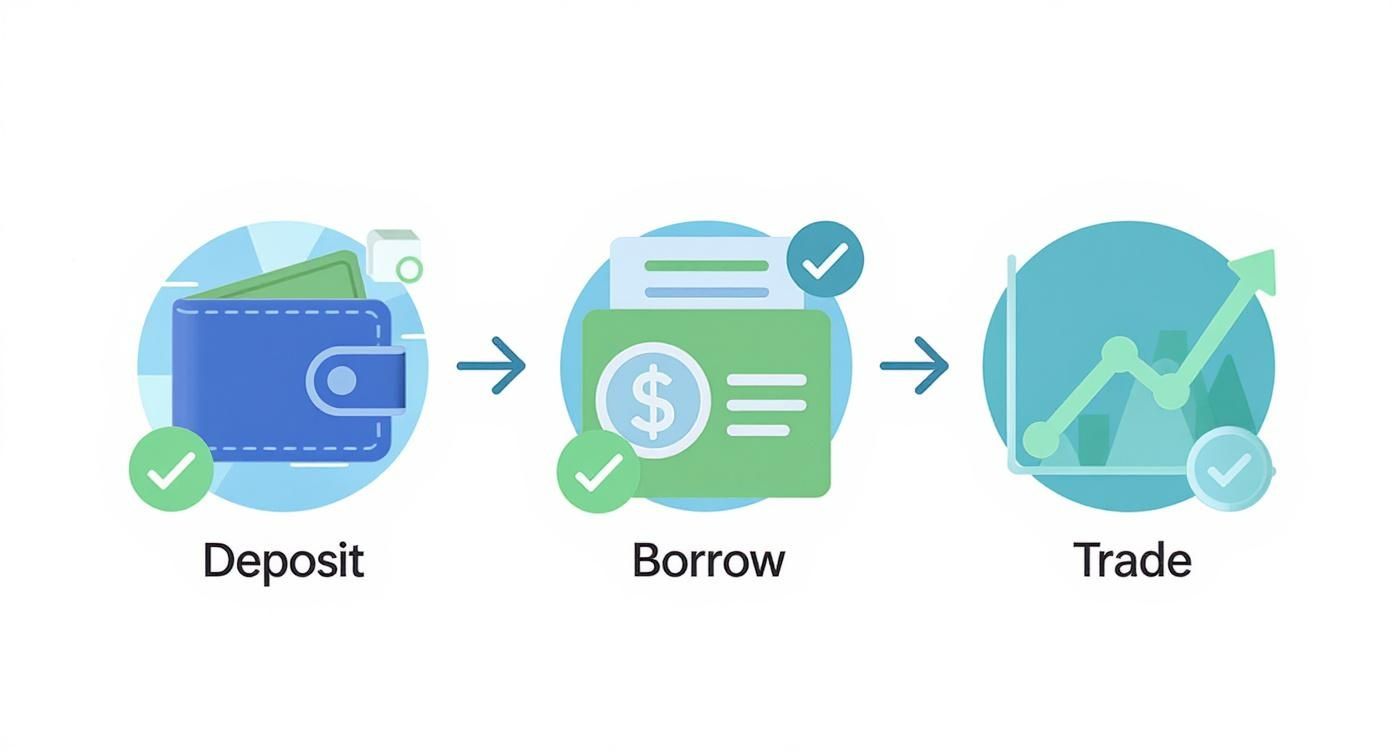
As you can see, margin trading isn't a single event. It's a process where your deposit serves as the foundation for borrowing funds and, ultimately, placing your trade.
When Trades Go Wrong: Liquidation and Margin Calls
So, what happens when a trade moves so far against you that your equity drops below the maintenance margin level? This is where two of the scariest words in trading come into play: margin calls and liquidation.
It’s best to think of these not as penalties, but as automated safety nets. They’re built-in mechanisms to protect the exchange from taking a loss and to protect you from ending up in debt beyond your initial deposit.
A margin call is essentially a warning shot from the exchange. It's a notification that your position is dangerously close to being liquidated, giving you a final chance to deposit more funds to shore up your collateral.
If you don't (or can't) meet that margin call, the exchange will forcefully and automatically close your position. That's liquidation. They sell your assets at whatever the current market price is to repay their loan. Whatever is left over (if anything) is returned to you. Liquidation is the ultimate risk in margin trading, as it can wipe out your entire initial stake.
A Bitcoin Trade Example in Action
Let's walk through a quick example to tie all these concepts together.
Let's say Bitcoin is trading at $50,000, and you're bullish—you think the price is heading up. You decide to open a $10,000 long position using 5x leverage.
- Opening the Position: To control a $10,000 position with 5x leverage, you need to put up $2,000 as your initial margin ($10,000 / 5). The exchange fronts you the other $8,000.
- A Winning Scenario: Bitcoin rips higher by 10% to $55,000. Your $10,000 position is now worth $11,000. You close the trade, repay the $8,000 loan, and walk away with $3,000. Your initial $2,000 turned into a $1,000 profit—a 50% gain on your capital from just a 10% market move.
- A Losing Scenario: Instead, the price of Bitcoin drops by 10% to $45,000. Your $10,000 position is now worth only $9,000. You decide to cut your losses and close the trade. After repaying the $8,000 loan, you're left with just $1,000. That 10% drop in price resulted in a 50% loss of your initial margin. If the price had fallen much further, you would have faced liquidation.
The Unbreakable Rules of Risk Management
Winning every trade is a fantasy. In the world of crypto margin trading, your long-term survival doesn't depend on being right all the time—it hinges on how well you manage being wrong. The goal is to build a rock-solid risk management framework that keeps you in the game, even when the market throws you a curveball.
This all starts with one non-negotiable rule: never risk more than 1-2% of your total trading capital on a single trade. This isn't just a suggestion; it's the lifeline that separates professional traders from gamblers. Sticking to this rule means a string of bad trades becomes a minor setback, not a catastrophic event that wipes you out.
Your Most Important Tool: The Stop-Loss Order
The most practical way to enforce that 1-2% rule is with a stop-loss order. It’s an automated command you set on the exchange to close your position if the price hits a specific level. Think of it as your pre-planned escape route.
This simple tool takes raw emotion out of the equation. No more hoping a bad trade will turn around; no more watching a small loss spiral into a devastating one. You decide before you even enter the trade what you're willing to lose, and the stop-loss acts as your unemotional enforcer.
Actionable Insight: When going long, set your stop-loss just below a recent support level or swing low. For a short position, place it just above a key resistance level. This gives your trade a logical invalidation point based on market structure.
In the volatile crypto markets, trading without a stop-loss is like walking a tightrope without a net. Sooner or later, you're going to fall.
How to Calculate Your Position Size
Once you’ve got your risk percentage and stop-loss level figured out, it's time to determine your position size. This isn't a random number you pull out of thin air. It’s a precise calculation designed to ensure that if your stop-loss gets hit, you lose exactly your pre-determined amount (e.g., 1% of your account) and no more.
Here’s the formula every trader should have tattooed on their brain:
Position Size = (Total Capital x Risk Percentage) / (Entry Price - Stop-Loss Price)
Using this formula systematically strips greed and fear from your decision-making. It forces you to size your trades based on cold, hard logic instead of gut feelings.
Let's Walk Through an Example
Imagine you're working with a $1,000 trading account. Here’s how you’d put the formula to work:
- Total Capital: $1,000
- Risk per Trade: 1% (which is $10)
- Asset: Bitcoin (BTC)
- Planned Entry (Long): $50,000
- Stop-Loss Price: $49,500
Now, plug those numbers into the formula:
Position Size = ($1,000 x 0.01) / ($50,000 - $49,500)Position Size = $10 / $500Position Size = 0.02 BTC
The math tells you exactly what to do: open a position for 0.02 BTC. If the market turns and hits your stop at $49,500, you’ll lose precisely $10. The other 99% of your capital remains safe and ready for the next opportunity.
Taming the Psychological Demons
Leverage doesn't just amplify gains and losses; it amplifies emotion. The psychological pressure of margin trading can be intense, with two major culprits constantly trying to sabotage your plan: greed and the fear of missing out (FOMO).
- Greed: This is the voice whispering that you should use way more leverage for that "sure thing" trade. It’s what pushes you to ignore your risk rules in pursuit of a massive payday, and it almost always ends badly.
- FOMO: This is that gut-wrenching feeling you get watching a coin pump without you. It triggers an impulsive urge to chase the price, usually leading you to buy at the top right before a correction.
The best way to fight these impulses is to build discipline through practice. Before you put real money on the line, get your reps in. You can learn how to paper trade crypto to test your strategies and make risk management an automatic habit. This simulated practice helps you execute your plan flawlessly when your capital is actually at stake.
Actionable Margin Trading Strategies
Knowing the mechanics and managing your risk is one thing, but actually putting that knowledge to work with a clear strategy is what separates the winners from the losers. Theory is great, but consistent execution is where the money is made.
A repeatable plan is the bedrock of successful crypto margin trading. Let's dig into two common strategies—one built for fast-paced day traders and another for swing traders who have a bit more patience—and I'll walk you through some real-world examples.
The Day Trader’s Breakout Strategy
Day traders live for short-term volatility. Their goal is to jump on quick, explosive price moves and get out. One of the most classic ways to do this is with a breakout strategy. This approach revolves around finding key price levels where an asset has repeatedly stalled out (resistance) or bounced from (support).
The idea is pretty simple. When a coin has been stuck under a heavy resistance level, a strong push through that level can act like a slingshot, triggering a rapid surge as buyers pile in. That "breakout" is precisely what you’re waiting to trade.
An Actionable Example with Ethereum (ETH)
Let’s say Ethereum has been bouncing off a ceiling at $3,500. For days, every rally has died right at that number. This coiling action often builds up a ton of pent-up buying pressure just waiting to be unleashed.
Here's how a day trader could map out a leveraged long trade for this exact scenario:
- Entry Trigger: You don't want to jump the gun. Instead, you'd place a conditional "buy stop" order just a tick above the resistance, maybe at $3,505. This ensures your trade only gets filled after the price proves it has the strength to break through.
- Stop-Loss Placement: Your safety net is everything. A tight stop-loss order goes just below the breakout point, say at $3,480. If it turns out to be a fakeout and the price tumbles back down, you're kicked out of the trade for a small, pre-defined loss.
- Take-Profit Target: A good rule of thumb is to shoot for at least a 2:1 risk-to-reward ratio. In this case, you're risking $25 per ETH (the distance from $3,505 to $3,480). A solid first target would be $3,555, which would lock in a $50 profit.
By defining every single parameter—entry, stop-loss, and take-profit—before you even enter the trade, you take emotion completely out of the equation. The market will either prove you right or hit your stop. Your only job is to follow the plan.
The Swing Trader’s Trend-Following Strategy
Swing traders aren't looking for a quick scalp. They operate on longer timeframes, like the 4-hour or daily charts, trying to catch bigger moves that play out over several days or even weeks. A powerful way to do this is with a trend-following strategy. It’s all about identifying a strong, established trend and looking for a discount to get in.
This isn't about chasing huge green candles. It's about patiently waiting for the market to pull back during a healthy uptrend and joining the party. Technical indicators like moving averages are your best friend here; they help you see the underlying trend and pinpoint those perfect entry opportunities.
A Practical Example with Solana (SOL)
Imagine Solana is in a beautiful uptrend on the daily chart, grinding higher with a clear pattern of higher highs and higher lows. You notice the 50-day Exponential Moving Average (EMA) is acting like a magnetic floor—every time the price dips down to touch it, buyers step in and push it higher.
Your plan is to use the next pullback to that 50-day EMA as your launchpad for a leveraged long. Here’s the blueprint:
- Identify the Trend: First, confirm the uptrend is still intact. Is the price action healthy? Is the 50-day EMA still sloping upwards and holding above the 200-day EMA? Check.
- Wait for the Entry Signal: Now, you wait. You don't chase the price; you let it come to you. You're watching for SOL to pull back and test that 50-day EMA, which let's say is currently around $150.
- Define Your Risk: Once you enter, your stop-loss goes below a logical point of invalidation—like the most recent swing low and comfortably below the moving average. Placing it at $142, for example, gives the trade some wiggle room.
- Set Profit Targets: In a strong trend, scaling out is often a smart move. You could set your first profit target at the previous major high (e.g., $175) and let the rest run, maybe trailing your stop up to lock in gains.
These strategies give you a framework, a set of rules to guide your decisions. Whether you’re a day trader hunting breakouts or a swing trader riding the trend, the core principle never changes: plan your trade, then trade your plan.
For those who want to take rule-based trading to the next level, our guide on algorithmic trading strategies dives into how you can automate these kinds of plans for even greater precision.
How to Choose a Margin Trading Platform
Picking the right platform for crypto margin trading is a lot like a professional chef choosing their knives. The right tool won't guarantee success, but the wrong one can definitely lead to disaster. Your exchange is your command center, so things like liquidity, security, and fees aren't just minor details—they're mission-critical.
Your first fork in the road is deciding between a centralized exchange (CEX) and a decentralized exchange (DEX). They offer two fundamentally different paths, each with its own trade-offs.
Centralized Exchanges (CEXs)
Think of centralized exchanges like Binance and Bybit as the titans of the trading world. They operate like traditional financial institutions, managing everything from the order books to your funds. Their biggest draw is deep liquidity. This means you can get in and out of large positions without the price slipping away from you.
These platforms are also loaded with advanced trading tools, sophisticated order types, and detailed charting interfaces that serious traders expect. The sheer volume flowing through them is hard to comprehend.
The crypto derivatives market, which is where margin trading lives, really shows the power of these platforms. By mid-2025, derivatives made up about 76% of all global crypto trading volume, with monthly volumes peaking at a staggering $8.94 trillion. This just goes to show how much liquidity is concentrated on these venues. You can discover more insights about these market statistics at SQ Magazine.
Decentralized Exchanges (DEXs)
On the other side of the coin, you have decentralized exchanges. Platforms like dYdX or GMX let you trade directly from your own crypto wallet, which means you always hold your own keys. This "self-custody" model gives you more control and removes the risk of an exchange getting hacked and losing your funds.
The trade-off? DEXs often have less liquidity. This can sometimes lead to higher slippage, especially on bigger orders. And while they're getting better every day, the user experience can feel a bit raw if you're new to the space.
CEX vs. DEX at a Glance:
- Custody: CEXs hold your funds for you. With DEXs, you hold your own.
- Liquidity: CEXs almost always have deeper liquidity and faster execution.
- Anonymity: DEXs usually offer more privacy since many don't require personal verification (KYC).
- Tools: CEXs tend to offer a more polished, feature-rich trading experience.
Decoding the Fee Structures
Fees are the silent killer of profitability in trading. On margin platforms, they come in a few different flavors, and you need to know what you’re paying for.
- Trading Fees: This is the standard commission (maker/taker fee) you pay on every single trade. Simple enough.
- Interest on Borrowed Funds: You're trading on a loan, so you have to pay interest on it. This is typically charged by the hour or day and the rate changes depending on the asset you're borrowing. For example, borrowing USDT on Binance might cost 0.001% per hour, but this rate fluctuates based on supply and demand.
- Funding Rates: This one is unique to perpetual contracts, a popular tool for margin traders. A "funding rate" is exchanged between long and short positions to keep the contract's price anchored to the actual spot price of the asset. You’ll either pay or receive this fee, usually every eight hours. If the rate is positive, longs pay shorts. If it's negative, shorts pay longs.
Ultimately, choosing the right platform is a balancing act. You have to weigh the deep liquidity and slick tools of a CEX against the self-custody and transparency of a DEX. Whatever you choose, get a firm grip on the fee structure—it will have a direct and significant impact on your bottom line.
Using Modern Tools for Trade Planning
The line between professional crypto margin trading and pure gambling often comes down to one thing: planning. Seriously. The pros map out every detail of a trade before they risk a single dollar, and modern analysis tools give them an incredible edge in doing so. This isn't about guesswork; it's about building a repeatable, disciplined process.
Think of a forward-planning tool as your trade's blueprint. It lets you clearly visualize exactly what you're trying to do. You can pinpoint strong support levels for your entry, tuck a strategic stop-loss just underneath to define your exact risk, and even set multiple take-profit targets to scale out of the position as it moves in your favor. But the real magic is in the automatic position sizing.
By simply plugging in your entry, your stop, and how much you're willing to risk—say, 1% of your total account—the tool does all the heavy lifting. It calculates the precise position size for you, guaranteeing that if the trade hits your stop, your loss is contained to that exact 1%. This is how you protect your capital and stay in the game.
Planning a Leveraged Solana Trade
Let's make this real. Imagine you're looking to go long on Solana (SOL) with leverage. You've been watching the chart and have identified a solid support zone where you expect buyers to show up. Instead of just jumping in, you build a complete plan first.
Here’s a glimpse of what that looks like inside a tool like CryptoMox, which lets you plot your entire trade strategy right on the chart.
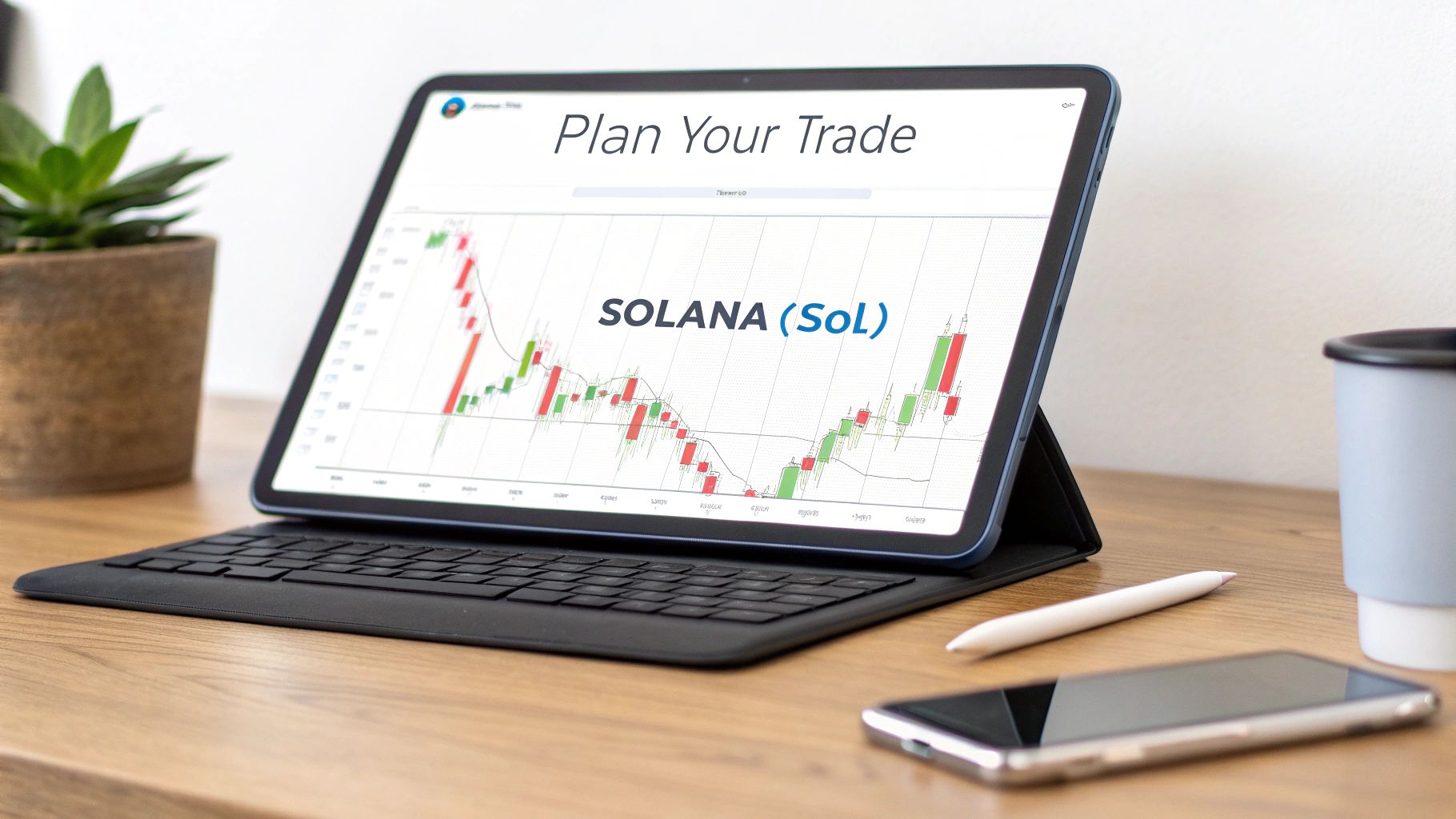
As you can see in the screenshot, the plan is all there: a clear entry near support, a stop-loss placed just below that key level, and a few profit targets on the way up. It’s all defined before the trade is even placed.
This kind of structured approach completely flips the script on how most people trade. You move from being reactive and emotional—chasing pumps and panic-selling dumps—to being proactive and strategic. You do your analysis, build your plan, and then you simply wait for the market to come to you. It's a game-changer for building confidence and consistency.
To really dial in your entries, you can layer this planning process with classic technical indicators. Our guide on how to use MACD and RSI is a great place to start, as it shows you how to spot momentum shifts and exhaustion points. Combining different analytical tools like this is how you build a truly robust trading strategy and gain the discipline needed for long-term success.
Answering Your Top Margin Trading Questions
Even with a solid grasp of the mechanics, a few questions always come up when traders start digging into margin. Let's clear the air on some of the most common ones.
Can You Actually Lose More Than You Put In?
On most reputable crypto exchanges today, the answer is a firm no. They have built-in safeguards, often called "negative balance protection."
If your trade goes south and hits the liquidation point, the exchange automatically closes your position. This prevents your account balance from ever dipping into the red. So while you can absolutely lose 100% of the margin you posted for that trade, you won't end up owing the exchange money you don't have.
This is a huge safety net and a key difference from some old-school brokerage accounts where a negative balance was a real, terrifying possibility.
Isn't This Just the Same as Futures Trading?
It's easy to see why people mix these up. They're similar, but not the same thing. Both use leverage to amplify your trading power, but what you're actually trading is different.
- Margin Trading: Think of this as borrowing money to buy the actual coins on the regular spot market. You own the asset, just with borrowed funds. For example, opening a 2 BTC margin long position means you are effectively buying and holding 2 BTC using borrowed capital.
- Futures Trading: Here, you're not buying the coin itself. You're buying a contract to purchase or sell a crypto at a set price on a future date. For example, buying a 2 BTC futures contract means you're agreeing to a price for 2 BTC in the future, without actually holding the coins now.
Things get a little blurry with perpetual futures contracts, which are hugely popular. They act a lot like spot margin trading but have their own unique quirks, like funding rates that traders pay or receive periodically.
How Does the IRS Handle Margin Trades?
Let's be clear: crypto tax is complicated, and margin trading adds another layer. The most important thing to know is that nearly every move you make is a taxable event.
Here's what the IRS is looking at:
- Closing a Position: The moment you close a trade, whether you booked a profit or a loss, you've created a taxable event. It's considered a disposal of property, and you'll have a capital gain or loss to report.
- Getting Liquidated: A forced liquidation isn't a get-out-of-jail-free card for taxes. The IRS treats it just like a voluntary sale. Your assets were sold to cover the debt, and that's a taxable event.
- Swapping Coins: Using margin to trade one crypto for another? That's also a taxable event.
You have to be meticulous with your records. Every single trade, fee, and liquidation needs to be tracked. This is the only way you'll be able to calculate your cost basis accurately and report your gains and losses correctly on forms like the IRS Form 8949.
Ready to stop guessing and start planning? CryptoMox gives you the forward-looking analysis tools to map out your entries, stops, and targets with discipline. See potential market paths before they happen and trade with a clear, data-driven plan.